
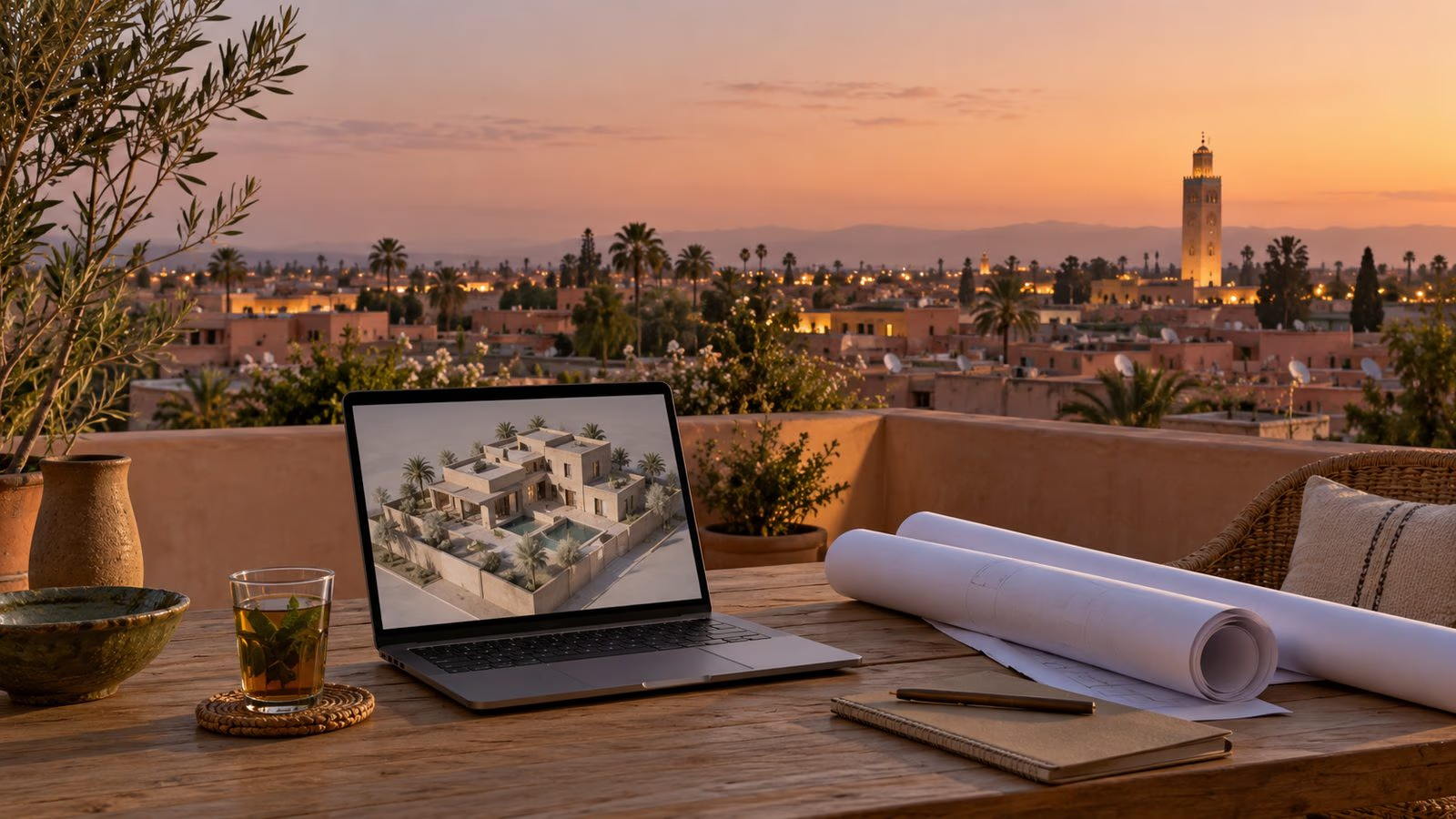
Many owners of villas and riads in Marrakech live in London, Paris, Brussels or Dubai. They have found the plot or the house they love, but one question holds them back: how do you run a construction project several hours' flight away without losing your budget or your peace of mind?
The answer is organisation: a local architect who represents you on site, decisions taken at the right time, and regular, verifiable information. Here is how we organise projects for clients who live outside Morocco.
The real risks of a remote project
The first risk is not dishonesty, it is the absence of a qualified eye. Without someone checking the works day to day, small gaps add up: a dimension not respected, a material swapped, poor waterproofing. You discover them too late, when fixing them means demolition.
The second risk is decisions made in a hurry, over the phone, without drawings or prices. The third is budget drift, caused by vague specifications at the start. All three are handled the same way: complete design before construction, and professional supervision during it.
How to organise your project remotely
- 01
Secure the purchase
Have a notary check the status of the plot or riad, and ask the architect for a feasibility study before you sign.
- 02
Choose a local architect to represent you
Give them a full mission, design and site supervision included. Our advice on choosing an architect in Marrakech helps you compare.
- 03
Design remotely
Video calls, annotated drawings, 3D models and material samples sent to you: design works very well from abroad.
- 04
Prepare the formalities
The architect prepares and follows the building permit in Marrakech. For some signatures, a power of attorney can make things easier: your notary will advise you.
- 05
Tender on a precise file
Construction drawings and specifications let you compare equivalent bids and sign clear contracts.
- 06
Receive regular reports
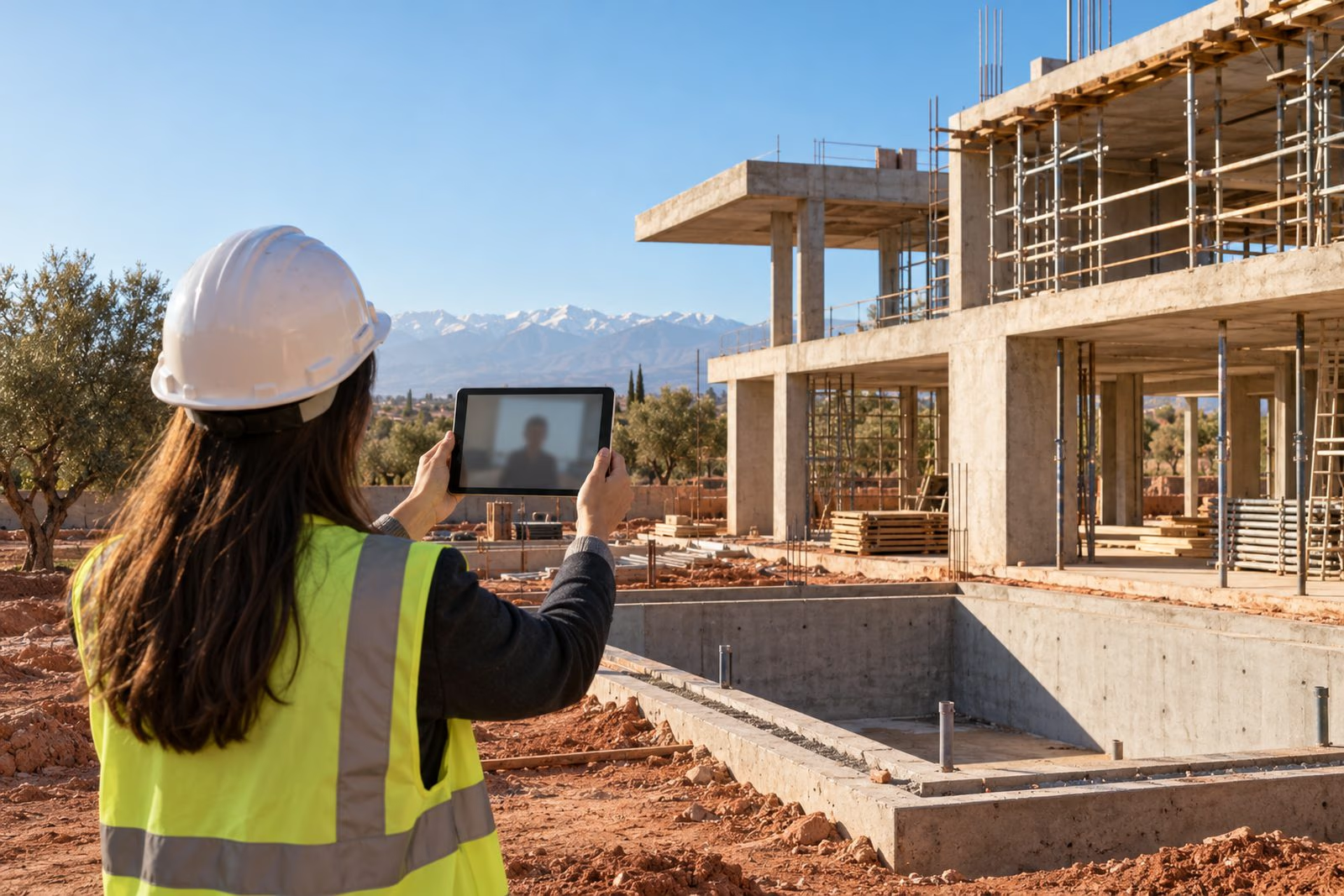
Dated photos, progress, decisions to make, budget committed: you follow your site week by week.
- 07
Visit at key moments
A few well-timed visits are enough: choosing materials, major construction milestones, handover.
- 08
Take delivery with confidence
The architect organises the handover inspection, lists the snags and follows their correction before you move in.
What a good site report contains
- Dated photos of every work area, taken from the same angles from one visit to the next
- Actual progress against the schedule, with any delays and their causes
- Decisions to make, with the options, their cost and a deadline
- Defects found and the planned date for fixing them
- Budget committed and any extra works, priced before they are carried out
- The next steps of the works and the date of the architect's next site visit
Keeping control of the budget remotely
From abroad, budget control rests on a few simple rules, set before the first spade goes in the ground. Precise specifications produce comparable quotes and limit surprises. Payments to contractors follow the actual progress of the works, checked and approved by the architect, rather than a fixed calendar.
Any extra work gets a written quote that you accept before it is carried out. Finally, a contingency reserve agreed at the start avoids having to make rushed trade-offs. With these rules, you always know where your budget stands, wherever you are.
- Detailed specifications before tendering to contractors
- Payments linked to progress approved by the architect
- No extra work without a written, accepted quote
- A contingency reserve included in the initial budget
- A budget tracker attached to every site report
Riad or villa: two different remote projects
A new villa is well suited to remote management: once the design is approved and the construction drawings are done, the works follow a predictable sequence. Renovating a riad holds more surprises, because the true condition of the walls, floors and services only appears once they are opened up. It calls for a thorough survey upfront, a larger contingency and more frequent decisions during the works.
In both cases, the architect's regular presence on site makes the difference. It means site discoveries are dealt with quickly and you receive priced solutions rather than problems.
When it is worth being there
| Moment | Why come |
|---|---|
| Before buying | Visit the plot or riad with the architect and understand its potential |
| Preliminary design approval | Optional: a video call is often enough, but a visit helps you picture the project |
| Choosing materials | Touch the samples, see the colours in Marrakech light, meet the craftsmen |
| Key construction milestones | See the built volumes before finishes, while adjustments are still simple |
| Handover | Check the quality and approve the correction of snags |
An architecture firm between Marrakech and London
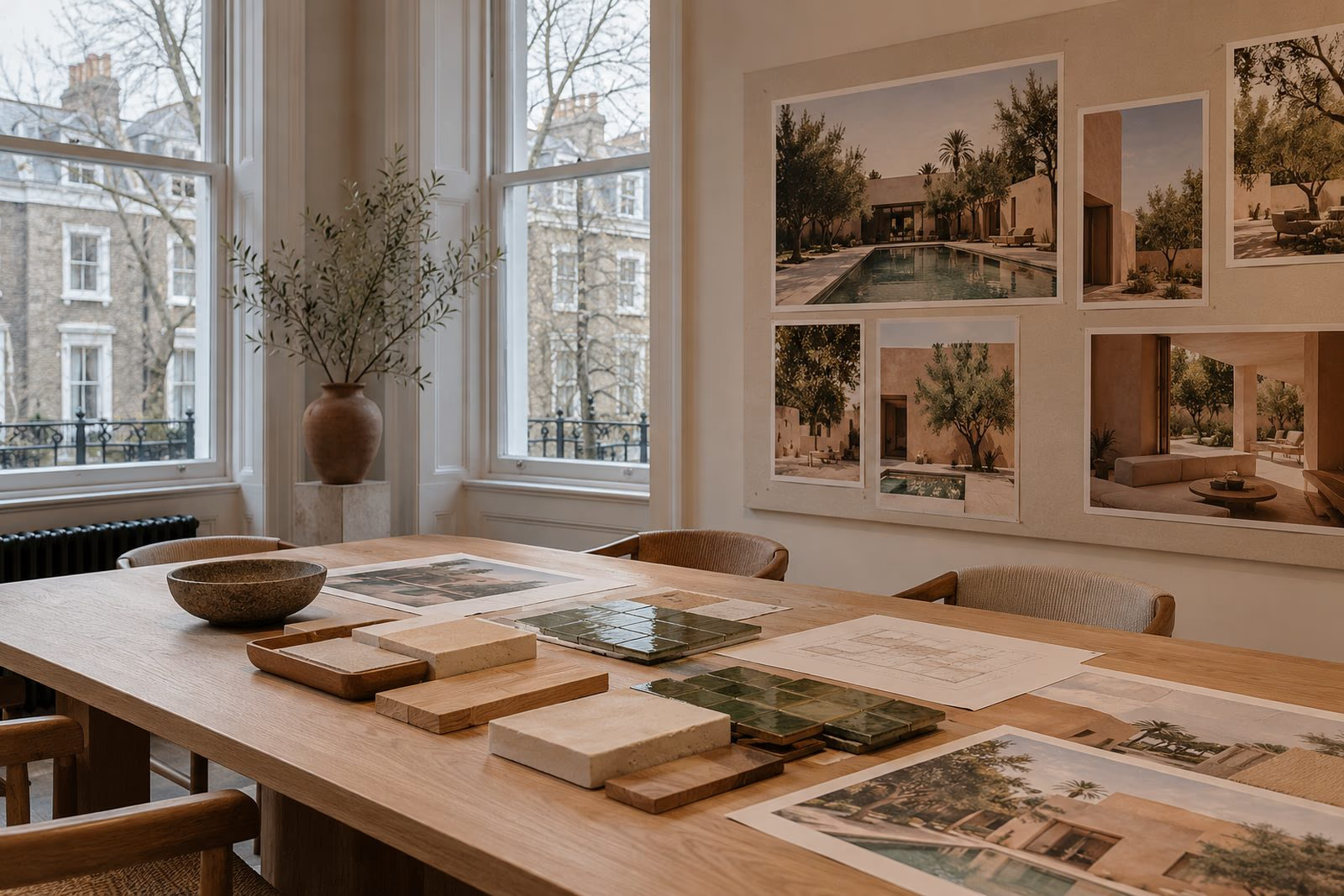
MORE Z Architects is based in Marrakech, in Prestigia Golf City, with an office in London. Clients living abroad find in us architects in Marrakech who are present on their site and a contact they can reach in their own time zone.
We design villas, renovate riads and provide site supervision on behalf of owners based in Europe and the Gulf. For an older property, discover our riad renovation service in Marrakech.
Frequently asked questions
Can a foreigner build in Marrakech?
+
Yes. A foreigner can buy titled land in an urban area or a riad and carry out works there. Agricultural land follows specific rules: have a notary check the property's status.
How can I follow a construction site in Marrakech from abroad?
+
Through an architect who supervises the site in person and sends you regular reports with photos, progress and decisions to make, alongside video calls.
Do I need to travel to Morocco for the building permit?
+
Not at every step: the architect prepares and follows the file. Some signatures may require your presence or a power of attorney; your notary and architect will tell you.
Do you renovate riads for clients who live abroad?
+
Yes. Survey, permits, craftsmen and site supervision: we manage the renovation on site and keep you informed at every stage.